
Executive Summary
As Indian enterprises navigate an unprecedented convergence of regulatory mandates, digital disruption, and geopolitical uncertainty in 2026, ISO 31000 has emerged as the definitive framework for building structured, board-aligned risk management capabilities. This article examines how forward-looking organizations are leveraging ISO 31000 principles to integrate emerging risks—from DPDP Act enforcement to AI governance—into a cohesive enterprise resilience architecture.
<p><strong>Executive Summary:</strong> The risk landscape confronting Indian enterprises in mid-2026 is categorically different from anything experienced in prior cycles. The simultaneous enforcement of India's Digital Personal Data Protection (DPDP) Act, the maturation of SEBI's cybersecurity resilience frameworks, the board-level elevation of AI governance, and the relentless expansion of third-party dependency risk have collectively rendered fragmented, reactive risk management not merely inefficient—but existentially dangerous. ISO 31000:2018, the internationally recognized standard for risk management principles and guidelines, offers organizations a structured, principles-based architecture to integrate these converging risk domains into a single, coherent management system. For C-suite leaders and governance professionals navigating this complexity, ISO 31000 is no longer a best-practice aspiration. It is a strategic imperative.</p>
<h2>The 2026 Risk Inflection Point: Why Traditional Approaches Are Failing</h2>
<p>Indian enterprises have historically managed risk in functional silos—IT security teams managing cyber risk, legal teams managing compliance risk, finance teams managing financial risk, and operations teams managing operational risk. This fragmentation was always a structural weakness. In 2026, it has become a critical liability.</p>
<p>Consider the regulatory environment alone. The DPDP Act has entered its enforcement phase, requiring organizations to maintain rigorous data mapping, operationalize consent management workflows, and execute breach response protocols that comply with CERT-In's six-hour incident reporting mandate. Simultaneously, SEBI's Cybersecurity and Cyber Resilience Framework (CSCRF) demands board-level accountability for cyber risk, with regulated entities required to demonstrate not merely policy readiness but measurable recovery performance. The Reserve Bank of India has similarly elevated its expectations for third-party and vendor risk management, requiring financial institutions to assess vendors based on their criticality to core business functions rather than simply conducting periodic audits.</p>
<p>Layered onto this regulatory complexity is the emergence of AI governance as a board-level risk discipline. Regulators and institutional investors now expect documented AI risk registers, algorithmic impact assessments, and human oversight mechanisms as non-negotiable components of enterprise governance frameworks. Organizations that have not yet formalized AI risk ownership and decision rights are operating with material governance gaps.</p>
<p>The consequence of siloed risk management in this environment is predictable: organizations find themselves managing the same underlying risk—say, a critical vendor's data handling practices—through three separate lenses (IT security, legal compliance, and procurement) with no unified view of aggregate exposure. ISO 31000 was designed precisely to resolve this structural failure.</p>
<h2>ISO 31000:2018 — Architecture, Principles, and What Makes It Distinctive</h2>
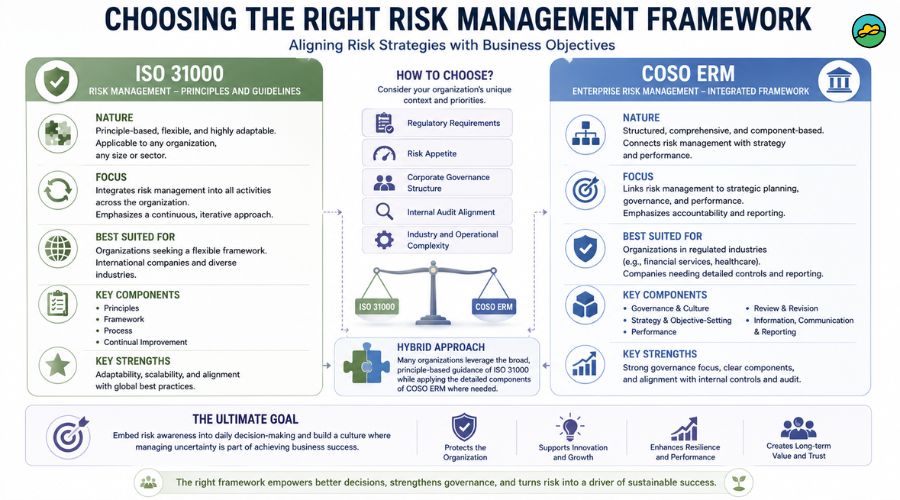
<p>ISO 31000:2018 is not a certification standard in the conventional sense—organizations do not receive an ISO 31000 certificate. Rather, it is a principles and guidelines framework that establishes the foundational architecture for how risk management should be structured, embedded, and continually improved across any organization, regardless of sector, size, or regulatory jurisdiction. This distinction is important: ISO 31000's value lies not in the credential it confers but in the management discipline it instills.</p>
<p>The standard is organized around three interconnected elements:</p>
<ul> <li><strong>Principles:</strong> ISO 31000 articulates eight foundational principles that define what effective risk management looks like in practice. These include the integration of risk management into all organizational processes, the structured and comprehensive nature of the risk management approach, the customization of frameworks to organizational context, the inclusion of stakeholder perspectives, and the dynamic responsiveness of risk management to changing internal and external environments. Critically, the 2018 revision elevated <em>human and cultural factors</em> as explicit principles—a recognition that risk management fails not because of inadequate frameworks but because of inadequate organizational culture and leadership commitment.</li> <li><strong>Framework:</strong> The ISO 31000 framework describes how an organization should design, implement, evaluate, and improve its risk management architecture. It places explicit responsibility on leadership and governance bodies—the board and C-suite—to demonstrate commitment through policy, resource allocation, and the integration of risk considerations into strategic decision-making. For Indian enterprises operating under SEBI's board-level accountability mandates, this alignment is directly actionable.</li> <li><strong>Process:</strong> The risk management process under ISO 31000 encompasses communication and consultation, scope and context establishment, risk assessment (identification, analysis, and evaluation), risk treatment, monitoring and review, and recording and reporting. This process is designed to be iterative and embedded within business operations rather than conducted as a periodic, standalone exercise.</li> </ul>
<p>What distinguishes ISO 31000 from more prescriptive frameworks such as COSO ERM or sector-specific regulatory guidance is its universality and scalability. It does not prescribe specific tools, methodologies, or metrics—it establishes the principles and process architecture within which organizations select the approaches most appropriate to their context. This makes it an ideal integrating framework for Indian enterprises that must simultaneously comply with multiple regulatory regimes and international standards.</p>
<h2>Integrating Emerging Risk Domains: DPDP, AI, and Cyber Resilience Through an ISO 31000 Lens</h2>
<p>The practical power of ISO 31000 in 2026 lies in its capacity to serve as the integrating architecture for risk domains that organizations are currently managing in isolation. Three domains in particular demand immediate attention from Indian enterprise leaders.</p>
<p><strong>Data Privacy Risk under the DPDP Act:</strong> The DPDP Act's enforcement phase introduces a category of regulatory risk that is simultaneously a legal compliance obligation, an operational risk, a reputational risk, and—for organizations processing sensitive personal data—a strategic risk. Under ISO 31000's process framework, organizations should formally establish the context for data privacy risk by mapping the full scope of personal data processing activities, identifying the internal and external stakeholders affected (data principals, regulators, business partners), and defining the risk criteria against which DPDP-related exposures will be evaluated. Risk treatment plans must address not only the technical controls required for data protection but also the organizational controls—consent management workflows, breach response protocols, data principal rights mechanisms—that regulators will scrutinize during enforcement actions. Critically, ISO 31000's emphasis on monitoring and review ensures that data privacy risk management is not a one-time compliance exercise but a continuously updated process that responds to regulatory guidance, enforcement precedents, and changes in data processing activities.</p>
<p><strong>AI Governance Risk:</strong> The elevation of AI governance to a board-level risk discipline reflects a fundamental shift in how regulators and stakeholders conceptualize technology risk. AI systems introduce risk categories that traditional IT risk frameworks do not adequately address: algorithmic bias, model drift, explainability failures, and the concentration of decision-making authority in automated systems without adequate human oversight. ISO 31000's principles of integration and inclusivity are directly applicable here. Organizations should embed AI risk assessment within the same risk management process used for all enterprise risks—establishing AI risk criteria, conducting structured impact assessments for high-consequence AI applications, maintaining documented AI risk registers, and assigning clear ownership for AI risk treatment and monitoring. This approach satisfies emerging regulatory expectations while avoiding the proliferation of disconnected AI governance frameworks that create their own coordination risks.</p>
<p><strong>Cyber Resilience and Third-Party Risk:</strong> SEBI's CSCRF and RBI's third-party risk management guidelines share a common philosophical foundation with ISO 31000: risk management must be outcome-focused, not documentation-focused. Regulators are explicitly moving away from accepting static policy documents as evidence of risk management maturity. They want scenario analysis, recovery performance metrics, and demonstrated evidence of risk treatment effectiveness. ISO 31000's process framework—with its emphasis on risk monitoring, review, and the recording of outcomes—provides the structural basis for generating exactly this kind of outcome-based evidence. Organizations that implement ISO 31000 rigorously will find that they are simultaneously building the evidence base that regulators now demand.</p>
<h2>Implementation Roadmap: From Principles to Embedded Practice</h2>
<p>Translating ISO 31000 from a framework document into an embedded organizational capability requires a structured implementation approach. Based on Praxis Consulting's advisory experience with Indian and multinational enterprises, the following phased roadmap reflects the critical success factors for sustainable implementation.</p>
<p><strong>Phase 1 — Leadership Alignment and Context Establishment (Months 1–2):</strong> ISO 31000 implementation must begin at the board and C-suite level. Leadership commitment is not a soft prerequisite—it is the first explicit requirement of the framework's principles. This phase involves conducting a board-level risk appetite workshop to define organizational risk criteria, establishing or rechartering the enterprise risk management governance structure (including the roles of the Chief Risk Officer, Risk Committee, and business unit risk owners), and completing a comprehensive context analysis that maps the organization's internal environment (strategy, culture, capabilities, existing controls) and external environment (regulatory landscape, competitive dynamics, stakeholder expectations, macroeconomic factors). For Indian enterprises, this external context analysis must explicitly address the DPDP Act enforcement timeline, applicable SEBI or RBI frameworks, and any sector-specific regulatory requirements.</p>
<p><strong>Phase 2 — Risk Assessment Infrastructure (Months 2–4):</strong> This phase involves designing and deploying the risk assessment methodology, including risk identification techniques (workshops, interviews, scenario analysis, horizon scanning), risk analysis approaches (qualitative and quantitative, as appropriate to risk category), and risk evaluation criteria aligned with the risk appetite defined in Phase 1. A unified enterprise risk register should be established that consolidates risks across all domains—strategic, operational, financial, compliance, technology, and reputational—with clear ownership, treatment plans, and monitoring schedules assigned for each material risk.</p>
<p><strong>Phase 3 — Integration with Business Processes (Months 4–8):</strong> The most common failure mode in ISO 31000 implementation is the creation of a risk management process that operates parallel to, rather than integrated within, core business processes. In this phase, organizations embed risk assessment requirements into strategic planning cycles, capital allocation decisions, major project approvals, vendor onboarding processes, and product or service launches. This integration ensures that risk management generates decision-relevant insights at the moments when decisions are actually being made—rather than producing retrospective reports that inform decisions already taken.</p>
<p><strong>Phase 4 — Monitoring, Reporting, and Continuous Improvement (Ongoing):</strong> ISO 31000's dynamic and iterative nature requires that organizations establish robust mechanisms for monitoring risk treatment effectiveness, tracking changes in the risk environment, and reporting risk information to appropriate governance levels. Board-level risk reporting should move beyond static risk heat maps to include trend analysis, treatment effectiveness metrics, and emerging risk horizon scans. Annual reviews of the risk management framework itself—assessing whether the framework remains fit for purpose given changes in organizational strategy and the external environment—are a core requirement of the standard.</p>
<h2>Measuring Maturity: The ISO 31000 Capability Progression Model</h2>
<p>One of the practical challenges organizations face in ISO 31000 implementation is the absence of a certification mechanism that provides an external validation of maturity. In the absence of a formal certification, organizations should adopt a structured maturity assessment model to benchmark their current state and define a credible improvement trajectory.</p>
<p>A five-level maturity model—ranging from <em>Initial</em> (ad hoc, reactive risk management) through <em>Developing</em>, <em>Defined</em>, <em>Managed</em>, to <em>Optimizing</em> (risk management as a strategic enabler with continuous improvement embedded)—provides a practical basis for self-assessment and gap analysis. Most Indian enterprises that Praxis Consulting engages with present at Level 2 or Level 3: they have defined risk management policies and processes, but integration with business decision-making remains inconsistent, risk culture is uneven across the organization, and the quality of risk reporting to governance bodies is insufficient to support outcome-based regulatory scrutiny.</p>
<p>The maturity assessment should evaluate capabilities across five dimensions: governance and leadership commitment, risk assessment methodology and tools, process integration and embedding, risk culture and competency, and monitoring and reporting quality. Organizations at Level 3 and above are demonstrably better positioned to satisfy the outcome-based compliance expectations of SEBI, RBI, and other Indian regulators—and to respond effectively to the dynamic risk environment of 2026 and beyond.</p>
<p>The convergence of regulatory enforcement, digital transformation, and stakeholder scrutiny has made enterprise risk management a true board-level strategic function. ISO 31000 provides the principled, scalable, and integrating framework that Indian enterprises need to build genuine resilience—not merely compliance posture. Organizations that invest now in embedding ISO 31000 as their risk management architecture will find themselves structurally advantaged: better able to anticipate emerging risks, faster in responding to regulatory demands, and more credible in the eyes of investors, customers, and regulators who are increasingly sophisticated in assessing risk management maturity. The question for senior leaders is not whether to implement ISO 31000, but how quickly and how rigorously.</p>
<p><em>Praxis Consulting's Standards and Assurance practice works with Indian and multinational enterprises to design, implement, and mature ISO 31000-aligned risk management frameworks tailored to their regulatory context and strategic objectives. If your organization is ready to move from reactive risk management to a structured, board-aligned enterprise resilience architecture, we invite you to connect with our advisory team for a complimentary risk management maturity diagnostic.</em></p>
Actionable Recommendations
Conduct a board-level risk appetite workshop within the next quarter to formally define organizational risk criteria and establish the governance mandate required for ISO 31000 implementation—without this leadership commitment, framework adoption will remain superficial and fail to satisfy SEBI and RBI outcome-based compliance expectations.
Consolidate your organization's fragmented risk registers—currently spanning IT security, legal compliance, and operational risk—into a single enterprise risk register aligned with ISO 31000's process architecture, assigning clear ownership and treatment accountability for each material risk category including DPDP Act exposure and AI governance gaps.
Integrate risk assessment requirements explicitly into strategic planning and capital allocation cycles so that ISO 31000 generates decision-relevant insights at the point of decision rather than producing retrospective reports; this integration is the single most effective lever for elevating risk management from a compliance function to a strategic capability.
Commission an annual ISO 31000 maturity assessment against a structured five-level capability model to benchmark your current state, identify critical gaps in process integration and risk reporting quality, and define a credible improvement roadmap that can be presented to the board and, where required, to regulatory bodies as evidence of risk management governance maturity.

Founder & Principal Consultant at Praxis Consulting with 30+ years of expertise in GRC, Enterprise Risk Management, and International Management Standards. A published author of Mastering ISO 17025, School Safety Blueprint, and ISO 19011:2026 — Auditing Excellence, he has trained over 5,000 professionals worldwide.